Love in Infant Monkeys by Lydia Millet
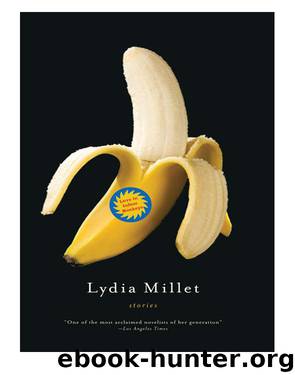
Author:Lydia Millet [Millet, Lydia]
Language: eng
Format: epub, mobi
Tags: Fiction, Short Stories (Single Author)
ISBN: 9781593763817
Google: Mswqxb1Z9v0C
Amazon: 1593762526
Barnesnoble: 1593762526
Publisher: Soft Skull Press
Published: 2009-01-01T05:00:00+00:00
Love in Infant Monkeys
HARRY HARLOW HAD A general hypothesis: Mothers are useful, in scientific terms. They have an intrinsic value, even beyond their breast milk. Call it their company.
In this hypothesis he was bucking a trend in American psychology. For decades experts on parenting had been advising mothers to show their children as little affection as possible. Too much affection was coddling, and coddling weakened a child. “When you are tempted to pet your child,” said a president of the American Psychological Association in a speech, “remember that mother love is a dangerous instrument.” This school of thought ran counter to what was believed by those not indebted for their child-rearing strategies to a rigorously monitored testing process. But it was dominant in the scholarship. To refute it, Harlow decided, the value of love would have to be demonstrated in a controlled experimental setting.
He worked long hours, seldom leaving his laboratory. With his experiments he made a name for himself, appearing on television programs and traveling the country on speaking engagements. He was seen as a rebel and an iconoclast. He spoke boldly of mother love, calling it “contact comfort.” He stressed its value to emotional health.
But he spoke harshly of his test subjects. “The only thing I care about is whether a monkey will turn out a property I can publish,” he said. “I don’t have any love for them. I never have. How could you love a monkey?”
To know how love works, a scientist must study its absence. This is simple scientific method; Harry admitted it. The suffering of lesser beings is often the price of knowledge. As he put it, “If my work will save only one million human children, I can’t get overly concerned about ten monkeys.”
Others were doing bold animal experiments at the same time, in the fifties, when Harry started, and after. Rats were dropped in boiling water, cats pinned down for months until their legs withered, dogs irradiated until their skin crisped, monkeys shot in the heads and stomachs or immobilized to have their spinal cords severed. When it came to the treatment of research animals, Harry was squarely in the mainstream. Only his willingness to speak bluntly was avant-garde.
He gathered disciples around him, young women and men who would continue his work, and decades later he would still be revered by psychology. While acknowledging the problem of what some might call animal cruelty, later scholars would view his collateral damage as a necessary unpleasantness. His chief biographer, a woman journalist, described him as a rose in a cornfield.
He was a high-functioning alcoholic, and there were long periods in his life when he was rarely sober. He had wives—first one, then another, then the first one again. He had two sets of children he never saw.
Harry Frederick Harlow had been born Harry Frederick Israel. Around the time of his doctoral dissertation he had changed his last name, not because he was Jewish—for he was not, in fact, Jewish—but because the name Israel sounded Jewish, and this made it hard to secure a good job.
Download
This site does not store any files on its server. We only index and link to content provided by other sites. Please contact the content providers to delete copyright contents if any and email us, we'll remove relevant links or contents immediately.
The Tidewater Tales by John Barth(12639)
Kathy Andrews Collection by Kathy Andrews(11793)
Tell Tale: Stories by Jeffrey Archer(9009)
This Is How You Lose Her by Junot Diaz(6854)
The Mistress Wife by Lynne Graham(6464)
The Last Wish (The Witcher Book 1) by Andrzej Sapkowski(5440)
Dancing After Hours by Andre Dubus(5267)
The Sympathizer by Viet Thanh Nguyen(4370)
Be in a Treehouse by Pete Nelson(4015)
The Secret Wife by Lynne Graham(3901)
Maps In A Mirror by Orson Scott Card(3877)
Tangled by Emma Chase(3738)
Ficciones by Jorge Luis Borges(3614)
The House on Mango Street by Sandra Cisneros(3448)
A Knight of the Seven Kingdoms by George R R Martin(3298)
Girls Who Bite by Delilah Devlin(3242)
You Lost Him at Hello by Jess McCann(3055)
MatchUp by Lee Child(2867)
Once Upon a Wedding by Kait Nolan(2779)
